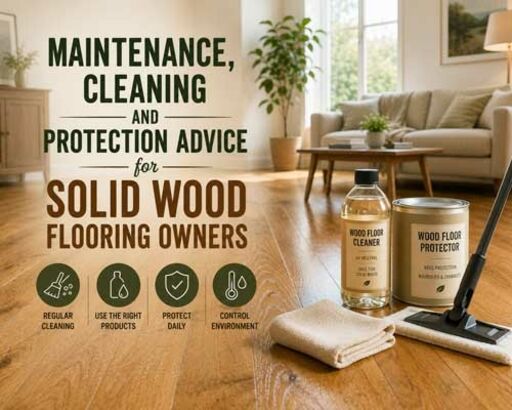
Solid hardwood floors have been a feature of quality buildings for centuries, and with appropriate care they genuinely can last that long. The difference between a solid floor that looks magnificent after 50 years and one that is damaged and dull after 15 is almost entirely about how it has been maintained. The good news is that proper maintenance of a solid hardwood floor is not complicated; it requires consistency more than effort.
Humidity: The Most Important Factor
Solid wood moves with changes in relative humidity. In dry winter conditions, particularly in centrally heated homes, the wood contracts and gaps appear between boards. In humid summer conditions, it expands and the boards press against each other. This is natural and expected behaviour in solid wood floors, and well-fitted floors with appropriate expansion gaps accommodate this movement without damage.
| Humidity level |
Effect on the floor |
| Below 35% RH |
Excessive gapping, possible surface checking |
| 45–65% RH |
Comfortable range, normal seasonal movement only |
| Very high humidity |
Swelling, risk of buckling if expansion gaps are insufficient |
Maintaining the room at a comfortable living humidity of around 45 to 65 per cent relative humidity is the best thing you can do for a solid wood floor. A basic hygrometer costing a few pounds allows you to monitor this.
Cleaning
Clean a solid wood floor with a microfibre flat mop and an appropriate wood floor cleaner, following the same principles as for engineered wood. Never use excessive water on a solid floor; the gaps between boards allow water to penetrate to the subfloor more readily than on a fully bonded engineered installation. A lightly dampened mop is always preferable to a wet one.
For oil-finished solid floors, Osmo Wash & Care or the equivalent cleaner for the specific oil brand maintains the floor properly. For lacquered solid floors, a pH-neutral cleaner compatible with the lacquer on the floor is the correct choice, our cleaners and polishers range covers both. Follow the maintenance schedule for the finish type as described in the relevant maintenance guides.
Maintaining the Finish on Solid Floors
Solid hardwood floors, particularly those finished on-site with a lacquer or oil, often develop more pronounced wear patterns in traffic paths than engineered floors do. This is partly because solid floors are finished in place and the finish film thickness can be less consistent than a factory finish, and partly because older solid floors may have been refinished several times with different products over the years.
Annual maintenance oil coats on oiled solid floors address wear in traffic paths effectively. Lacquered solid floors benefit from periodic screen-and-recoat on worn sections. The depth of material in a solid floor, typically 18mm to 22mm, means the floor can be sanded and fully refinished many times over its life, which is one of the great advantages of solid wood.
Sanding and Refinishing Solid Floors
When a solid hardwood floor has significant wear, deep scratching, or old finishes that can no longer be maintained by surface treatments, a full sand and refinish is the appropriate step. This process removes the top layer of wood along with the old finish, exposing fresh timber that can be finished to a completely new appearance, our floor lacquers and hardwax and oil ranges cover both finish types.
Solid Floor Care at a Glance
- Maintain humidity between 45 and 65 per cent relative humidity
- Clean with pH-neutral products appropriate to the finish
- Wipe spills immediately and avoid standing water
- Annual maintenance oil, or periodic screen-and-recoat, for worn areas
- Full sanding and refinishing when surface treatments are no longer effective
- Solid floors can be refinished many times: depth of material is a long-term advantage
A solid hardwood floor that is properly cared for is one of the most enduring things in any home. Unlike almost any other interior surface, it improves with age when looked after well, developing a character and patina that new floors do not have. The investment in proper care is modest compared to the value and longevity it preserves.
FAQ
How quickly should I wipe up a spill on a solid wood floor? Straight away. Solid floors have gaps between boards that let water reach the subfloor more easily than a fully bonded engineered floor, so standing liquid is more of a risk here than on other floor types.
Does central heating make solid wood floor care harder? It can, since centrally heated homes often run drier in winter, which is exactly the condition that causes excessive gapping. Keeping the room within the 45–65% humidity range, with a humidifier if needed, helps offset this.
How many times can a solid floor realistically be sanded over its life? It depends on the board thickness and how much material previous sandings have already removed, but with a typical 18mm to 22mm depth, a well-maintained solid floor can often be refinished several times across its lifespan.
Is it worth getting a hygrometer for every room with solid wood flooring? One in the main living area is usually enough to get a sense of typical conditions in the home, since humidity tends to be fairly consistent across connected rooms unless one has unusual heating or ventilation.